A Profession of Hope by Jenna Butler
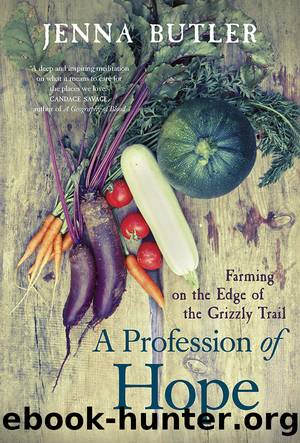
Author:Jenna Butler
Language: eng
Format: epub
Publisher: Wolsak and Wynn Publishers Ltd
Published: 2015-01-15T00:00:00+00:00
CHAPTER ELEVEN
A Year of Farm Food:
Community-Supported
Agriculture
NOT TOO LONG AFTER weâd planted our first large garden at the farm, we read Alisa Smith and J.B. MacKinnonâs The 100-Mile Diet: A Year of Local Eating. At that point, we were already eating, during the summers, from what we called âThe 100-Foot Dietâ â aside from meat, milk, butter and tea, we harvested just about all of our meals from the garden where we spent our days, cooking and eating in sight of the beds our food had come from. Increasingly, our friends in the city wanted to do the same, and realizing we were within reasonable driving distance of Edmonton, we ran with their enthusiasm and began a community-supported agriculture (CSA) food box program.
These programs have been around in one way or another for as long as farmers have been providing families in town with vegetables, eggs, milk and grain, but theyâve gained considerable cachet over the past fifteen years. When we began Larch Grove Farmâs CSA program, we were feeling our way forward based on what weâd read and learned about from small farmers in Alberta and British Columbia. There were a handful of other small farms around Edmonton offering CSA shares at the time, and these were relatively limited compared to the number of people who were interested in joining the programs. Because this would be our first year as a CSA farm and we were farther north than many of the others, we played a very conservative game with our pricing and offered a ten-week box program in sizes varying from a personal snack box to a large family hamper.
The main thing to understand with a CSA program is that itâs built on faith in both farmer and land. Customers pay up front for a summerâs worth of food months before they actually see the first bunch of spring onions or bag of spinach. The money comes in around seed-ordering time, mid-winter, right when small farmers are dreaming of delicious crops and comparing catalogues, calculating over and over again what they can afford to sow in a given year. The CSA money goes into start-up: seeds, pots, tools and the like. Itâs just whatâs needed to kick-start a market garden in the late winter.
After that, the contents of a CSA box are up to the farmer, the elements and the pests. Most farms will list the potential contents of a produce box at a number of points throughout the summer, but this can change with crop failure (and, likewise, with spectacular success â you can always tell if a farmerâs had a good kale year!). It may be variable in type, but the food is local, fresh and, with many small farms, grown without the use of pesticides and chemicals. For ten to fifteen weeks out of the year, a family with a CSA share can count on having enough weekly vegetables to satisfy the majority of their needs.
We began our CSA program on request from friends after they
Download
This site does not store any files on its server. We only index and link to content provided by other sites. Please contact the content providers to delete copyright contents if any and email us, we'll remove relevant links or contents immediately.
Whiskies Galore by Ian Buxton(42140)
Introduction to Aircraft Design (Cambridge Aerospace Series) by John P. Fielding(33239)
Rewire Your Anxious Brain by Catherine M. Pittman(18784)
Craft Beer for the Homebrewer by Michael Agnew(18333)
Cat's cradle by Kurt Vonnegut(15525)
Sapiens: A Brief History of Humankind by Yuval Noah Harari(14536)
Leonardo da Vinci by Walter Isaacson(13471)
The Tidewater Tales by John Barth(12744)
Thinking, Fast and Slow by Kahneman Daniel(12502)
Underground: A Human History of the Worlds Beneath Our Feet by Will Hunt(12217)
The Radium Girls by Kate Moore(12166)
The Art of Thinking Clearly by Rolf Dobelli(10691)
Mindhunter: Inside the FBI's Elite Serial Crime Unit by John E. Douglas & Mark Olshaker(9498)
A Journey Through Charms and Defence Against the Dark Arts (Harry Potter: A Journey Throughâ¦) by Pottermore Publishing(9333)
Tools of Titans by Timothy Ferriss(8571)
Wonder by R. J. Palacio(8219)
Turbulence by E. J. Noyes(8183)
Change Your Questions, Change Your Life by Marilee Adams(7915)
Nudge - Improving Decisions about Health, Wealth, and Happiness by Thaler Sunstein(7837)
